
I'm Ninad, and I FIREd at 33.
I'm a former software engineer who moved to the US at 23 with $40,000 in student loans. At 33 I achieved financial independence.
But FIRE at 33 meant planning a 50 year retirement, which is much tougher than the 30 years most advice is built for. So I had to make my own plan very thorough.
Along the way I painstakingly learnt a few things that the calculators and blogs I relied on were missing. I've talked and written about what they are in detail, in my interviews and on the blog.
I realized that reaching a FIRE number is just the beginning.
A plan that has to last 50 years also needs these.
Which is why I built
The F.I.R.E planner that starts where other calculators stop.
Because you need more than a FIRE number: a plan that survives a bad decade, a floor under your spending, and a success rate across thousands of real market years.
Step 1 of 7. Your five numbers.
Get started with step 1 today. Put in five numbers and you get your success rate: how often your money lasts to 90, tested against 1,500 futures built from real market years. You also see what would change it, in plain words.
Fill in the five fields. Your success rate and what would change it update as you type.
Steps 2 to 7 have launched. Build your full plan in about 10 minutes and get a report on it: what to change, what could break it, and how it would have done through 2000 and 2008.
Not here for your number? Continue to the blog.
Not convinced it's going to be good?
This is what you get. Every picture below is the planner itself, on a sample plan: 32 years old, stopping at 42, ₹2 crore invested, a child in school.
What a calculator says, and what real years say.
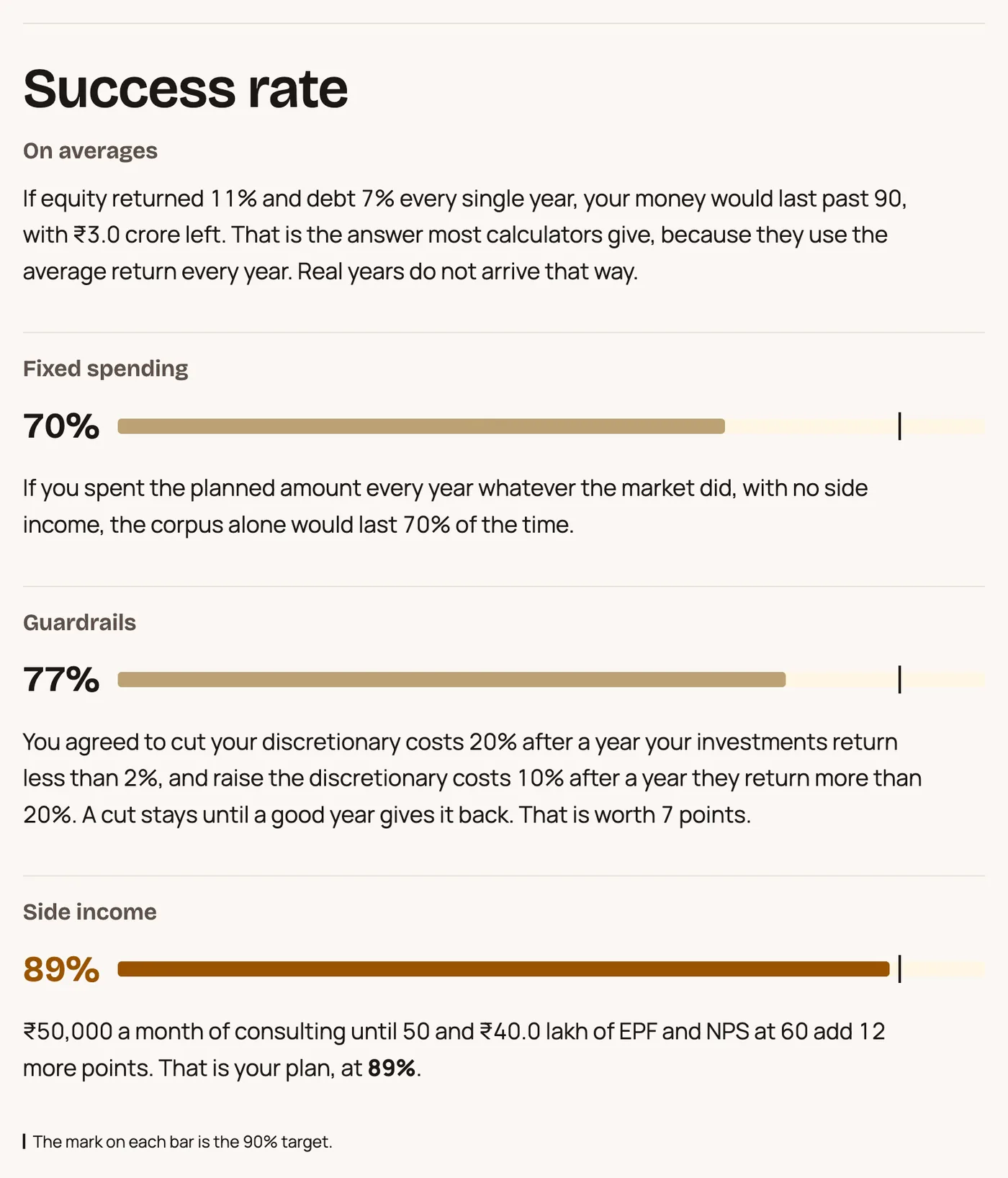
On the average return every year, this plan lasts past 90 with ₹3.0 crore to spare. Run through 1,500 futures built from real Nifty 50 years, it lasts 70% of the time. Guardrails and side income take it to 89%.
The same crash, early, late and never.
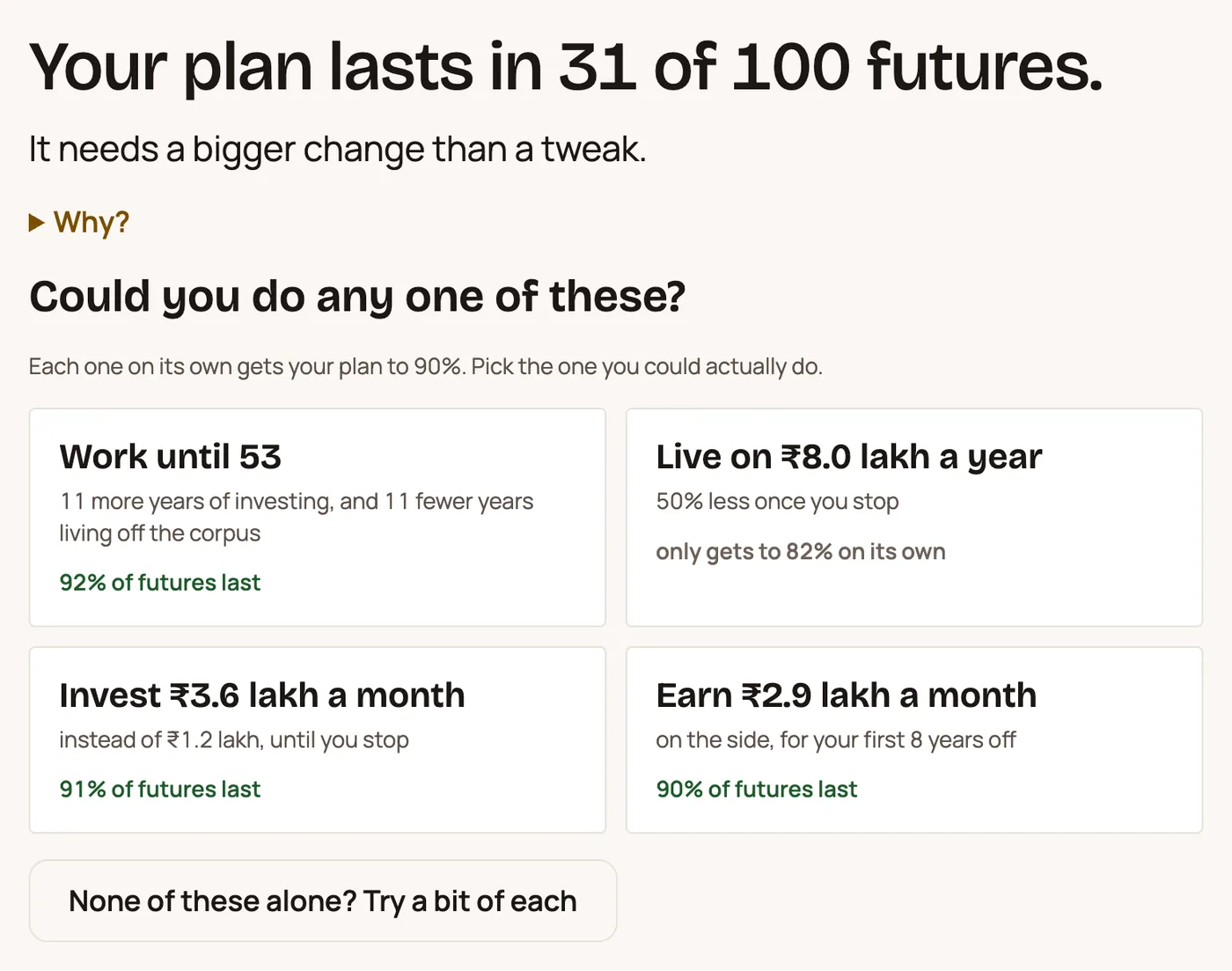
The dot-com crash in the year you stop leaves this plan ₹1.4 crore poorer at 90. The same four years arriving 20 years later cost it ₹0.8 crore. The order your returns arrive in is a risk of its own, and the report tests it on your plan.
If your plan is weak, it shows you a way out.
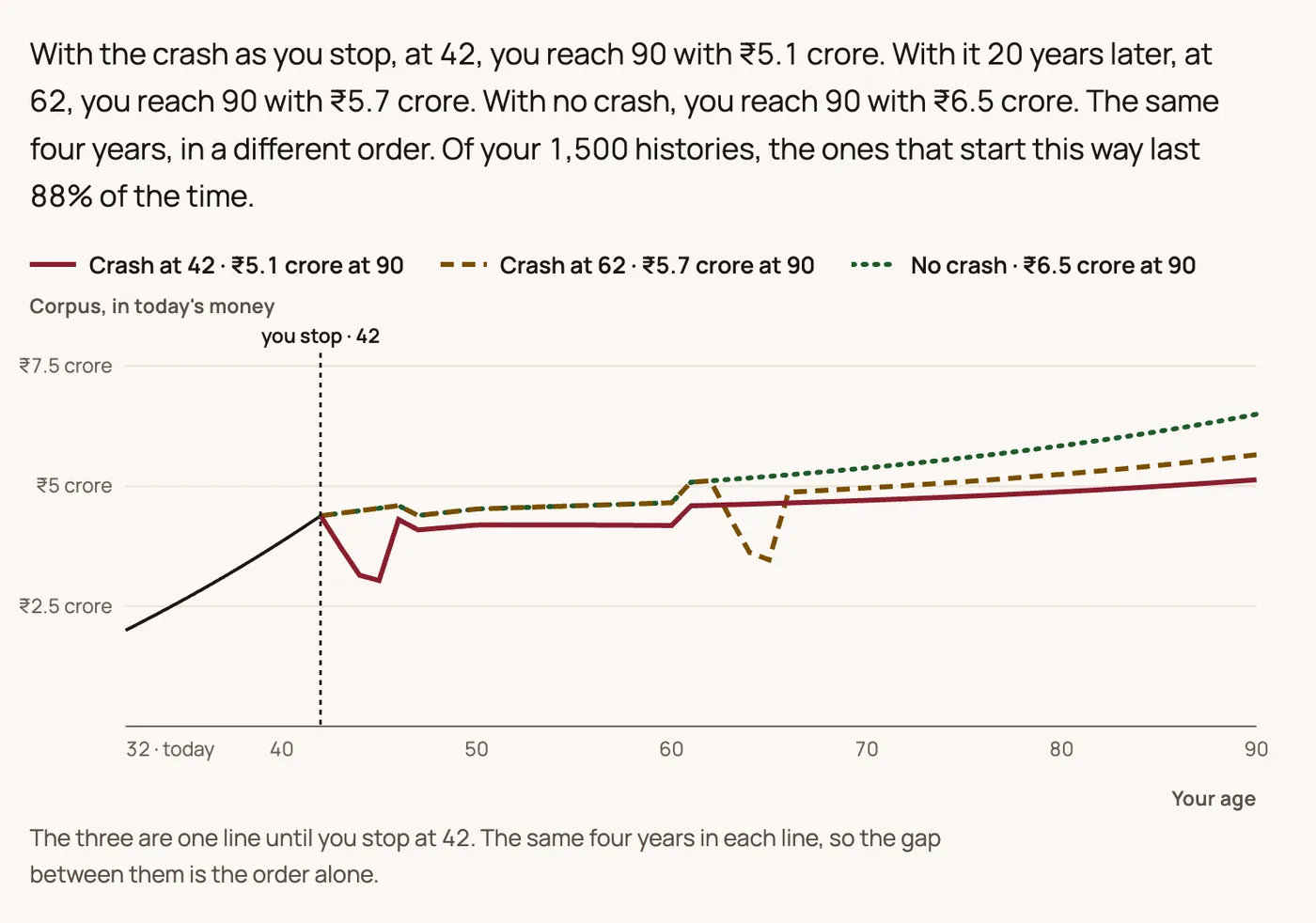
Below 75%, you see what each change would take on its own: work longer, spend less, invest more or earn on the side. Pick one, or try a bit of each, and the whole report is built on the plan you choose. Shown here on a weaker sample plan.
Your plan, through 2000 and 2008.
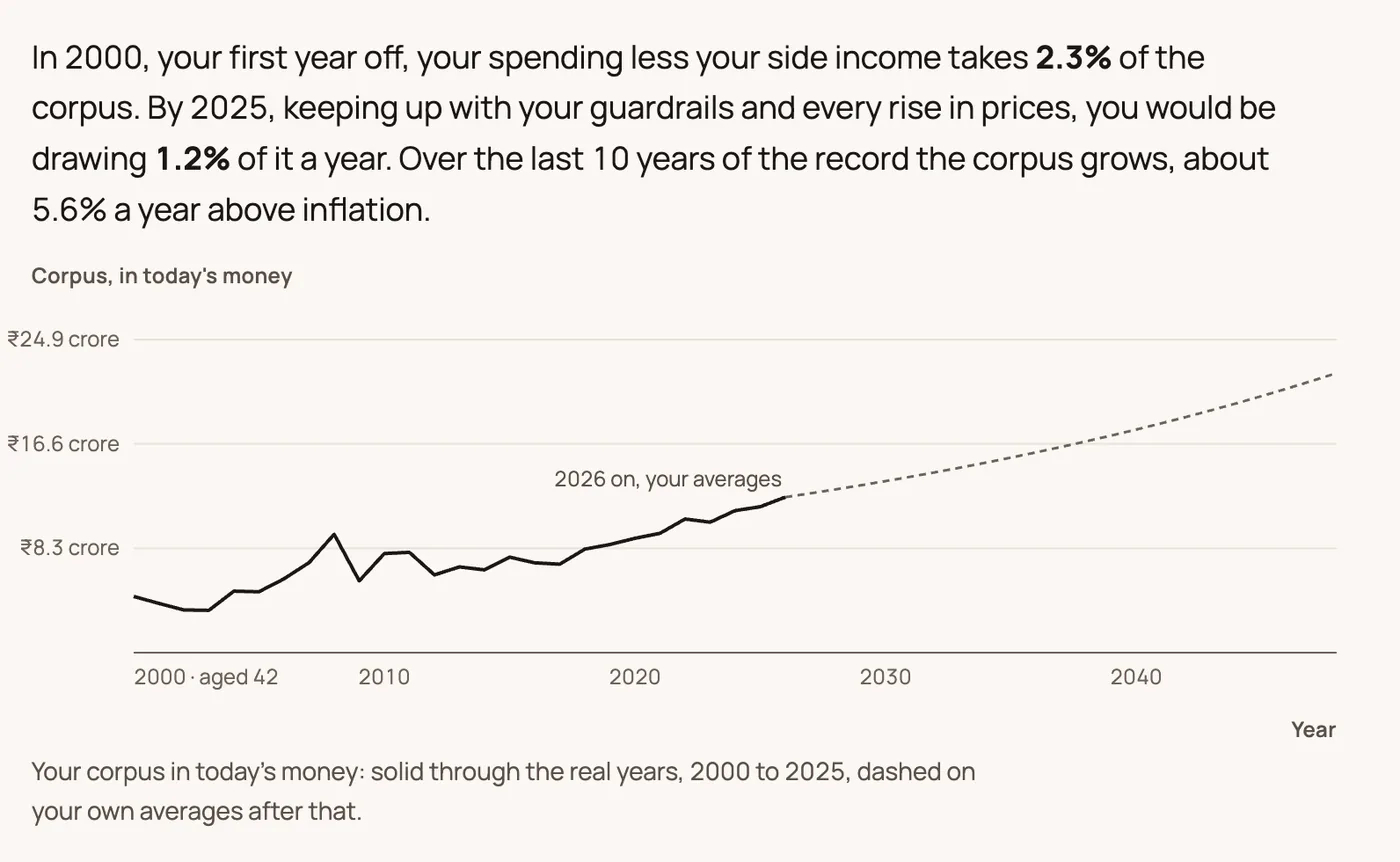
Stop on 1 January 2000 and live through both crashes with your own plan and rules. This one survives: by 2025 it draws 1.2% of the corpus a year, and the corpus has been growing about 5.6% a year above inflation.
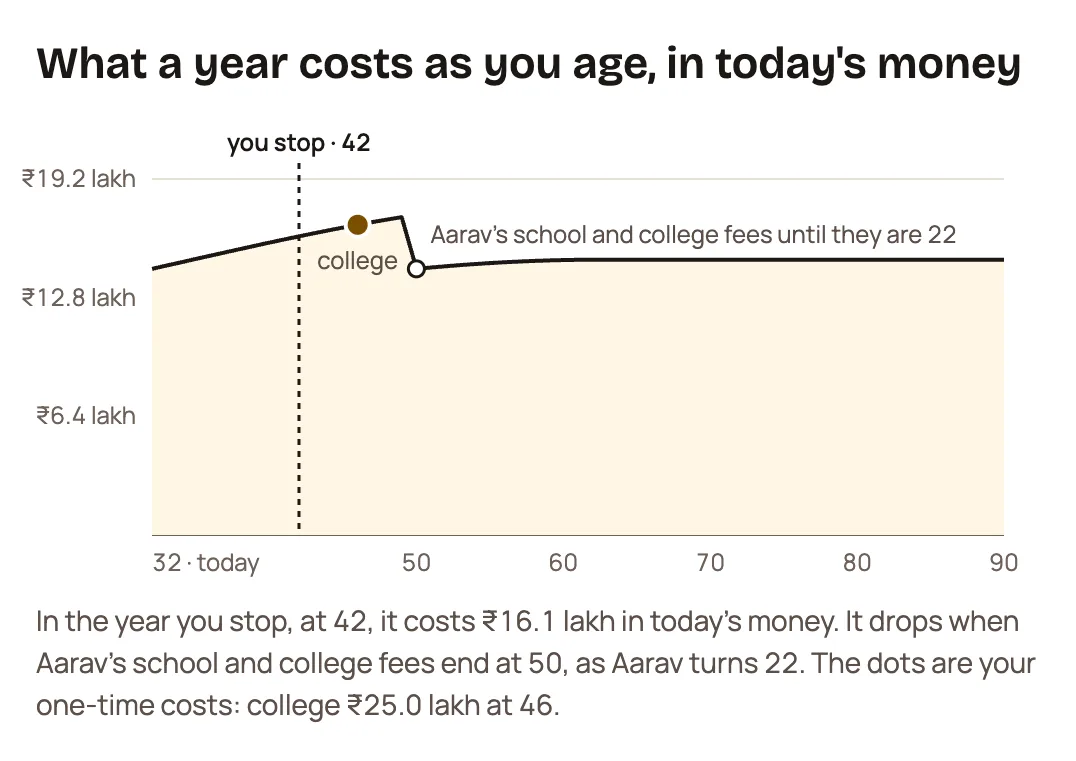
Every cost on its own clock.
School fees end when your child turns 22. Health rises at 12% a year, faster than prices in general. Your plan gets an inflation rate of its own, from your own costs.
And four more free tools, live today.
Questions about FIRE, the planner or living abroad? Book a free 15 minute call with Ninad.
Things people ask before they trust it.
"Isn't this the 4% rule with extra steps?"+
The 4% rule was built on 30 year retirements and one country's past returns. Stop in your early 40s and you're asking your market, after your inflation, to carry 45 or 50 years. The planner doesn't assume a rule; it tests your spending against real sequences of returns and tells you how often it holds.
"My situation isn't simple."+
Good, nobody's is. A child who leaves home at 22, parents who may need help later, a property that starts paying rent at 45, part time work that might dry up early, money in two currencies. Every one of those is an input with a start and an end, and the report tells you which of them the plan depends on most.
"Where do the market numbers come from?"+
Real calendar years for the market you choose, drawn in multi-year blocks so crashes and their recoveries stay together, then centred on the return you set. It can only recombine years that have already happened, so it cannot see a crash deeper than anything on record, and it says so on the report.
"Where does my data go?"+
It stays in your browser. Your numbers are kept in your browser's own storage, which is how you come back to them, and the PDF is generated on your machine.